
Geneva · built for Europe
A research initiative in development · looking for partners and funding
Mental-health care that listens, and keeps what it hears in the right hands.
haiva 4 gives mental-health practitioners time and attention back. sona 4 stays with their patients between sessions. Voice, measured carefully and shown only to the clinician, connects the two. The AI brings evidence; the clinician decides.
The time a patient takes before answering, and the pauses inside an answer, are among the things haiva measures, against the same patient’s earlier sessions. A fact for the clinician to interpret, never a diagnosis or a score. Illustration with invented values.
1.2 s99.4%
of a patient’s week happens between sessions
3,131
voice features per session in our first version, R3
1.1M+
nodes in the clinical knowledge graph, ICD-11 to SNOMED CT
0
risk scores, anywhere, in line with NICE NG225
Why this matters
Too few clinicians, and a week nobody sees
Too few clinicians, too much paperwork
The World Health Organization puts the global median at 13 mental-health workers per 100,000 people. Those in practice spend a large share of their time on documentation instead of care.
The weeks between sessions are invisible
A weekly session is one hour out of 168. A hard night, a small breakthrough, the early signs of relapse: by the next session most of it has faded.
Voice is rich, and easy to over-claim
Studies have repeatedly linked slower speech, longer pauses and flatter pitch with depression. The field is young. InnerEcho measures carefully, compares each value with the patient’s own history, and labels what is not validated.
1 of 168
One week, hour by hour. The lit square is the weekly session; sona is designed for the rest, with the patient’s consent.
The principle
AE-in-the-Care-Loop™: augmented evidence for human-led therapy
haiva does not make clinical decisions and does not act on its own. It provides measured evidence that flows through the care relationship. Every output stays under the practitioner’s review and control. The clinician validates; the AI provides evidence.
This is not a tool that thinks for the practitioner. It is a tool that helps them see more clearly.
| Automation with a human check | AE-in-the-Care-Loop | |
|---|---|---|
| Who decides | The system proposes a conclusion; a person approves or overrides it | The clinician decides; the system supplies evidence for the decision |
| What the AI produces | Classifications, scores, recommendations | Measures, drafts, sources and open questions, each labelled |
| When the data is poor | A result is produced anyway | “Not measurable”, with the reason |
| What the patient sees | Varies by product | No analysis, ever: their own record, diary and help |

haiva 4 · health ai voice assistant
The practitioner’s whole day, from intake to invoice
A clinical intelligence platform for psychiatrists, psychologists and psychotherapists. It extends what a practitioner can perceive and reduces the time spent on work that does not directly serve patients.
The voice behind the words
Sessions recorded and transcribed with consent for each purpose. Pitch, rhythm, jitter, shimmer, pauses and the timing between two speakers, each against the patient’s own history.
Notes the practitioner signs
SOAP or DAP notes, reports and invoices drafted from the session. Every sentence cites the moment it comes from. Nothing is final without a signature.
MED EVO: clinical knowledge
Cross-references what was said with ICD-11, ICD-10-GM and SNOMED CT, and points out gaps in the assessment. A prompt to ask, never a diagnosis.
Brief check-in calls
With consent, two-to-three-minute check-ins between sessions, led by sona, summarised for the practitioner before the next appointment.
Digital Echo™, privately
Reflective practice on the practitioner’s own speech timing and vocal load, visible to them alone. No emotion, stress or burnout inference: EU law forbids it at work, and we hold that line.
A safety net that does not depend on AI
Crisis items reach the Safety inbox and escalate if unacknowledged. Help now works offline and without sign-in. No risk score.
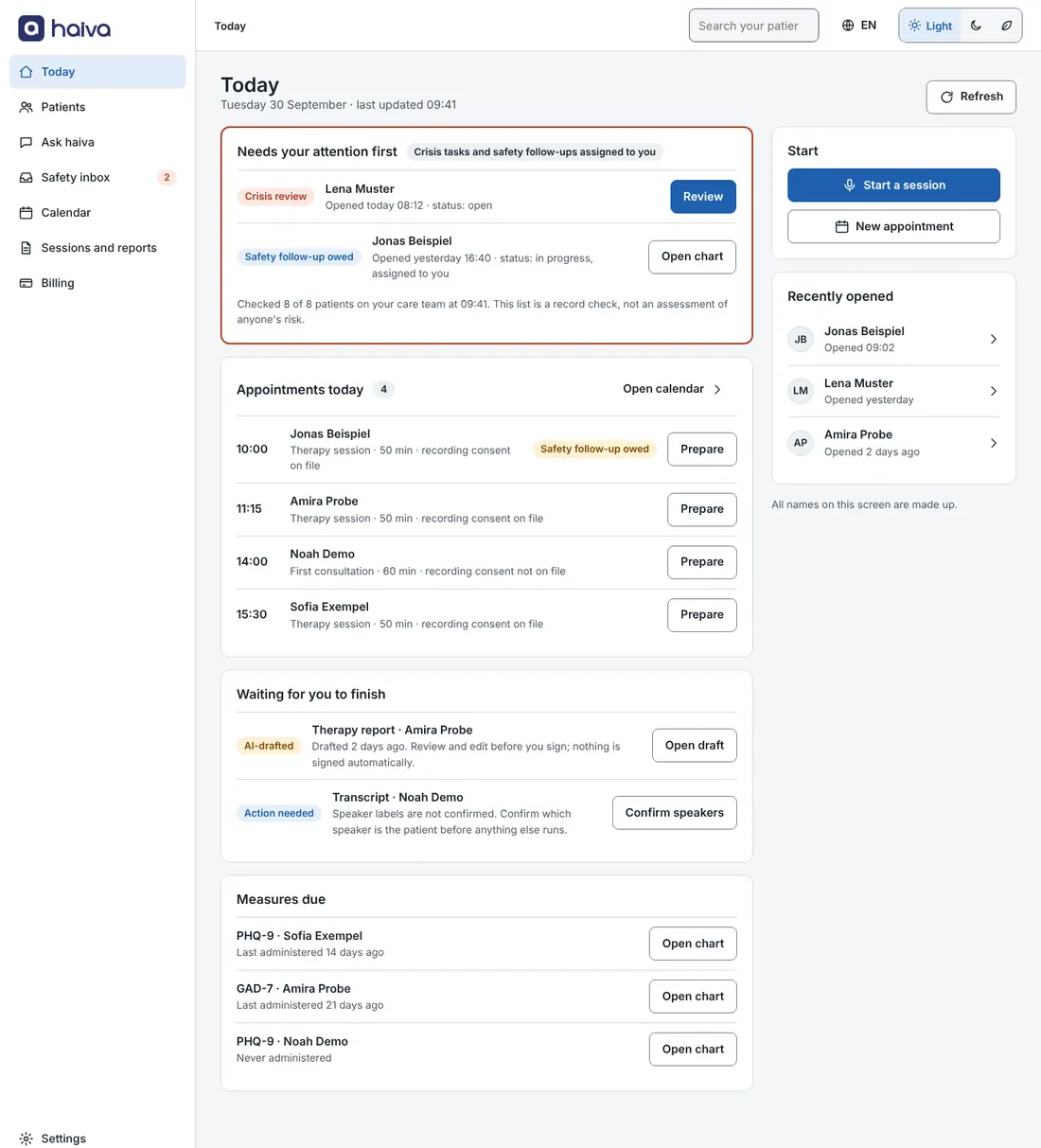
haiva 4 design prototype, made-up data.
Voice at the centre
What a voice can show a clinician, and what it must never claim
A recording already exists for the note, so measuring how the patient spoke needs no extra task, only separate consent. Every value is compared with the same patient’s earlier sessions, never with population norms or as a disorder score.
L1a · Timing
Speech rate, pauses, answer delay
Who waits how long before answering, and how that changes over weeks. Does not show mood or speed of thought.
L1b · Acoustics
Pitch range, loudness, voicing
Measured from the sound with published methods. Does not show sadness, anxiety or flat affect.
L2 · Own range
Difference from the patient’s baseline
Each value against this patient’s earlier sessions in the same setup. The clinician decides whether a difference matters.
Five gates before any value appears
- Consent and noticeVoice-analysis consent on file; the patient was told, in their language, before the first analysis.
- Speakers confirmedThe practitioner confirmed which voice is the patient. The practitioner’s own voice is never analysed here.
- Recording qualityEnough patient speech, enough signal above noise. A failed check is a gap, not a result.
- Personal baselineA set number of analysable sessions in the same recording setup.
- ValidatedUntil a method is validated, values stay in the research edition, labelled. Never shown to the patient.
MED EVO · clinical knowledge
A clinical knowledge graph
1.1M+
nodes
2.8M+
relationships
Built and running in haiva R3; carried into haiva 4 in its own database, apart from patient data. DSM-5-TR only under licence from its publisher.
Not yet explored in the assessment
History of manic or hypomanic episodes
Patient presenting with depression.
A prompt to ask. Never a diagnosis.
Example prompt, made-up patient.
sona 4 · for the patient
Beside the patient, between sessions
A companion for adults in active treatment whose practitioner has switched it on. It always says it is an AI, never diagnoses, and points back to people.
- Nothing analytic reaches the patientNo diagnosis, no score, no interpretation of their voice.
- Screen firstEvery message is checked for signs of crisis before any other step.
- Help now always worksNo sign-in, no network, no switch can turn it off.
- Honest AIsona says it is an AI, says when it does not know, and says when a person should take over.
Their record stays under their control: a private diary, what sona remembers (readable, correctable, hideable), consent for each use, export at any time. Crisis numbers for the country they are in, offline.
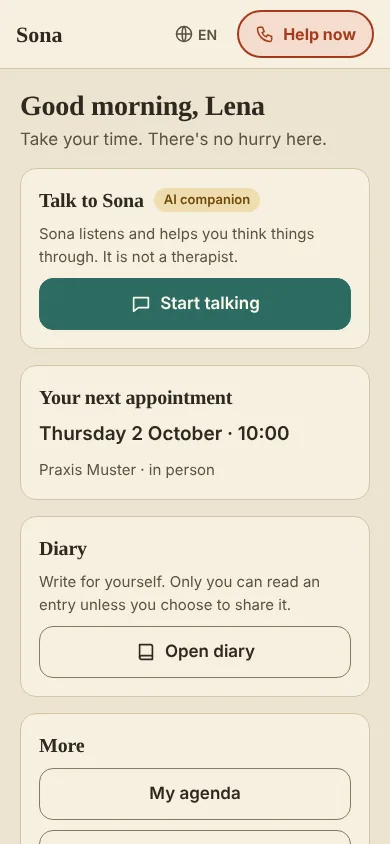
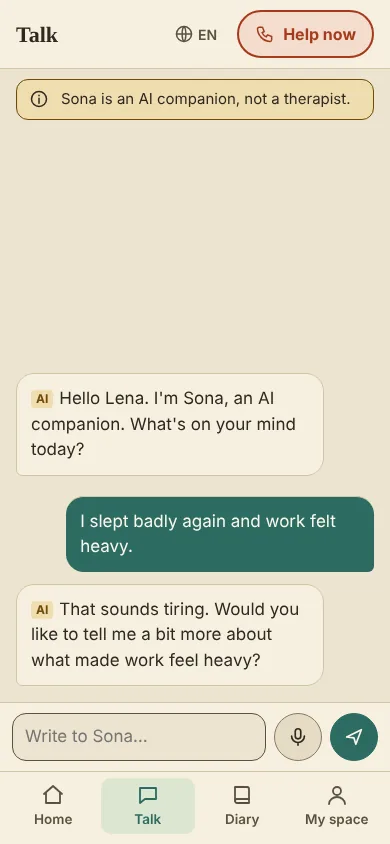
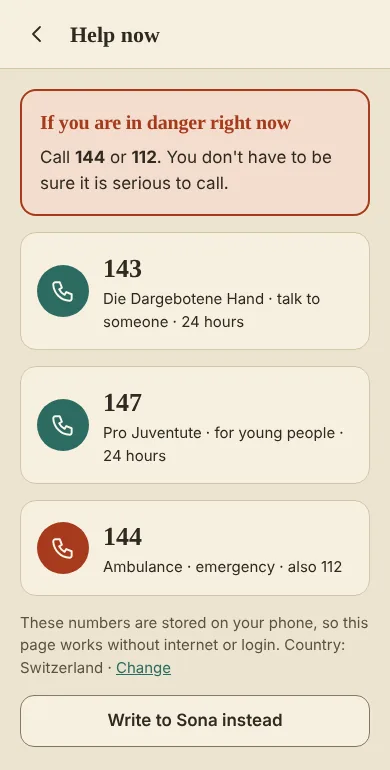
sona 4 design prototype, made-up data.
Nourish: food, the gut and the mind
A complete nutrition pipeline, from a food knowledge graph of more than 627,000 European products to private food notes, brought into sona under its clinical rules. Every claim carries an evidence label.
- Off by defaultSwitched on by the practitioner, per patient.
- Not offered with an eating disorderPresent or suspected; switched off again if eating concerns appear.
- No numbers about the personNo scores, calories, weights or targets; no good or bad food.
- The conversation stays separatesona never raises food, diet or supplements first.
Safety
No risk score.
A crisis signal reaches a person, not a number.
- Crisis items go to the clinician’s Safety inbox and escalate if nobody acknowledges them.
- Help now works offline and without sign-in. No switch can turn it off.
- In line with NICE guideline NG225, which advises against tools and scales to predict suicide.
Open source · MPL-2.0
Three open voice modules
Open, inspectable and able to run locally. Each works alone; they exchange files and JSON on one session clock, never code. In haiva 4 and sona 4 they sit beside the current pipeline, so the best one can be chosen on evidence.
Capture
captavoce
Seals audio in short chunks as it records. A stored recording is treated as a hazard, at home, at a checkpoint, in a war. Version 0.10, 213 tests.
Transcripts
tramavoce
Who spoke when, two speakers, benchmarked in the open on recordings with known truth. Ships no models; each listed with its licence.
Measures
meravoce
Each voice measure with its published source and evidence grade, or “not measurable” with the reason written into the result.
Built for Europe
Built in Geneva, designed for Europe
haiva 4 and sona 4 start in Switzerland because InnerEcho is in Geneva. Everything that depends on a country is a module, customised and adapted. The core never forks.
Crisis resources today
Built on haiva R3 and sona R3
3,131
voice features per session
haiva 4 and sona 4 build on haiva R3 and sona R3, our first working versions. They ran the whole chain end to end on demonstration records and taught us what a clinical product has to do differently. The full story is in the partner room.
Who it serves
The people in the room first, and everyone around them
Practitioners
psychiatrists, psychologists, psychotherapists
- Time back: notes, reports and invoices drafted for you to correct and sign.
- Presence in the room: haiva records and transcribes, so you listen instead of writing.
- Prepared for every session: a short brief with sources.
- Sight of the weeks in between: check-ins, questionnaires, what the patient chooses to share.
- A second pair of eyes on safety, and no risk score anywhere.
Patients
adults in treatment whose practitioner switches sona on
- Not alone between sessions: a companion that always says it is an AI.
- Help in one or two taps: crisis numbers and their safety plan, offline, without sign-in.
- Their record under their control: diary, memory they can read and correct, consent per use.
- Nothing that labels them: no score, no diagnosis, no reading of their voice.
Practices, clinics, hospitals
- One record in the FHIR standard with national profiles, three views of it.
- Each country’s work built in: tariffs, invoice formats and record-keeping rules.
- Control: roles, care teams, every read audited; hosted in the country of care or on your servers.
- No lock-in by design: every record exportable in a standard format.
Researchers and universities
professors, study investigators, students
- A research and education edition with every research module on and labelled.
- Open measurement code: each voice measure with its source, evidence grade and refusal reasons.
- Reproducible results: every value carries its module version and input fingerprint.
- A calibration workspace for named investigators of an approved study.
Health insurers and payers
- Clean claims: invoices drafted from signed records, in each country’s format.
- Measurement-based care: validated questionnaires followed over time in the practice.
- Privacy that protects everyone: a payer receives what an invoice requires, and no voice data, ever.
- A question worth studying together: what changes in costs, relapses or hospital days.
Regulators and notified bodies
- Medical-device discipline from the first task: requirements, hazard log, decision records, test evidence.
- The EU AI Act by design: no emotion recognition on practitioners; patients told before any voice analysis.
- Conservative claims: no diagnosis, no risk prediction, in line with NICE NG225.
- Inspectable methods: published sources, evidence grades, versions.
Associations and professional bodies
- Practitioner-led by design: the profession sets the wording the product may use.
- Crisis resources per country, reviewed by native-speaking clinicians.
- A partner for guidance on AI in therapy: consent, scribes, voice analysis, minors.
- Open code the profession can audit.
Funders and investors
foundations, philanthropists, impact investors, angels, venture funds
- A large, underserved need: too few clinicians and a week nobody sees.
- A defensible core: voice and speech timing in therapy, a working research prototype, a clinical knowledge graph, a safety design built around NICE guidance.
- A model without lock-in: practices, clinics and hospitals pay for certified releases, sovereign hosting, country modules and support.
Humanitarian and crisis settings
- Local-first: designed so that everything can one day run on local hardware.
- For low-income countries and crisis or war settings.
- Open, consented, multilingual speech infrastructure where today there is almost none.
The path
Research edition first. The clinical edition is the goal.
One code base, two editions: what differs is which modules are switched on, enforced on the server and audited. A platform that stays in the lab does not help a single patient.
1 · First
Research and education
Universities, research programmes, teaching with synthetic patients. Most modules on, all labelled.
2
Studies
Study investigators with consenting adults, under ethics approval. A clinical safety lead signs off.
3
Evidence
Sealed evaluation sets, clinician review, published methods, validation with university partners.
4 · The goal
Clinical edition
Practices, clinics, hospitals. A module is on only when its evidence and approvals allow. Certified releases.
Commitments
The lines we hold
Nothing becomes part of the record without a practitioner’s signature.
No diagnosis, no score, no reading of their voice.
Crisis signals go to a person to look at.
Help now works without sign-in, network or any switch.
Their own voice is measured only if they switch it on, and only for them.
Research use only with ethics approval and consent for that purpose.
sona ends when therapy ends. Success is measured in care, not minutes.
Every voice value carries its evidence grade and “not validated” label.
Partner room
More detail, for partners
For funders, universities, clinicians and future partners. Access by password, on request.
No password yet? Write to us below.
Inside
- The narrated presentation and the slides
- Every haiva 4 and sona 4 prototype screen
- The haiva R3 and sona R3 website archive
- What carries forward from R3, and what changes
- The path and the next steps
Partners
Working with InnerEcho
The step from research to the clinic is not one a single team takes alone.
InnerEcho offers
- The research and education editionFree to universities and research programmes, when released.
- Three open voice modulesMPL-2.0, free to use.
- A health-grade design others can reuseConsent per purpose, audited access, offline crisis help, verifiable deletion reports.
InnerEcho is looking for
- FundingGrants, donations, pre-seed and seed: foundations, philanthropists, impact investors, business angels, venture funds.
- Clinicians and universitiesA clinical safety lead, study investigators, validation partners.
- Infrastructure and pilotsSovereign GPU hosting; practices, clinics and hospitals ready for a research pilot.